

Press Brake Selection Guide
How to Choose Press Brake Tonnage
Sheet thickness alone cannot determine the right machine. Learn how material strength, actual bend length, V-die opening and forming method affect the tonnage required for a CNC press brake.
Start With the Right Question
Three Questions Every Buyer Should Understand First
Why can’t tonnage be selected by thickness alone?
Because the required force also depends on material tensile strength, actual bend length, V-die opening and forming method. The same 6 mm sheet may require very different machines.
What information is needed for an accurate recommendation?
Material grade or tensile strength, maximum thickness, maximum actual bend length, inside-radius or flange requirements, process type and part drawings.
Why not choose the smallest machine that can theoretically bend the part?
A machine operating close to its limit leaves little tolerance for material variation, tooling changes, special forming and future production demands.
Correct selection logic: Material Strength → Thickness → Actual Bend Length → V-Die Opening → Bending Method → Special Forming → Required Force → Machine Tonnage and Operating Margin
Core Selection Factors
What Determines the Required Press Brake Tonnage?
Material
Higher tensile strength requires greater forming force.
Thickness
Air bending force rises rapidly as sheet thickness increases.
Bend Length
Longer actual bending lines require proportionally greater total force.
V Opening
A smaller lower-die opening increases force and affects radius.
Process
Hemming, bottoming and special tooling must be calculated separately.
Material Tensile Strength
Required bending force is directly related to the material’s tensile strength, commonly expressed as Rm. Mild steel is often used as the baseline for standard calculations, while stainless steel and high-strength steel may require substantially higher force. Whenever possible, the actual tensile-strength value should be confirmed from the material certificate.
| Material Condition | Selection Consideration |
|---|---|
| Mild steel | Common baseline for air-bending estimates. |
| Stainless steel | Generally requires more bending force than standard mild steel. |
| Aluminum | Generally requires less force, depending on alloy and temper. |
| High-strength steel | Requires strength-based calculation and often a larger V opening. |
Actual Bend Length, Not Machine Length
A 3,200 mm press brake does not mean every tonnage calculation should be based on a 3,200 mm full-length bend. The calculation must use the maximum actual bend length required on the thickest material. For identical material, thickness and tooling, a 3,000 mm bend requires approximately three times the force of a 1,000 mm bend.
V-Die Opening
In air bending, the lower V-die opening influences forming force, natural inside radius and minimum flange length. For standard steel bending, a common starting point is a V opening approximately six to eight times the sheet thickness. A smaller V opening can produce a smaller formed radius, but it increases both bending force and tooling load.
Important: A larger V opening may reduce the required tonnage, but it cannot be selected purely to reduce machine size. The drawing must still allow the resulting inside radius and minimum flange length.
Air Bending Calculation
Basic Tonnage Formula
For standard air bending, a commonly used calculation method estimates the forming force using sheet thickness, V-die opening, actual bend length and material tensile-strength correction.
Forming Tonnage = {[575 × Material Thickness²] ÷ Die Opening ÷ 12} × Bend Length × Material Factor × Method Factor × Tooling Factor| Parameter | Meaning |
|---|---|
| Material Thickness | Sheet thickness used for the maximum forming requirement. |
| Die Opening | Lower V-die opening selected for the required bend result. |
| Bend Length | Actual length formed in one bending operation. |
| Material Factor | Actual tensile strength divided by the formula baseline tensile strength. |
| Method / Tooling Factors | Corrections required for processes or tooling other than standard single air bending. |
This formula is a starting point for machine selection. Final confirmation must also include tooling capacity, clamping load, part geometry, production frequency and operating margin.
Worked Example
6 mm Mild Steel × 3,000 mm Bend Length
Assume the customer requires a standard 90° air bend on a 6 mm mild-steel sheet over a full 3,000 mm bend length, using a V48 lower die opening.
This estimate applies to the stated material assumption, V48 die and standard single air-bending operation.
| Bend Length | Force at V48 |
|---|---|
| 1,000 mm | Approximately 55 metric tons |
| 2,000 mm | Approximately 110 metric tons |
| 3,000 mm | Approximately 165 metric tons |
| Lower Die Opening | Estimated Force for 6 mm × 3,000 mm | Practical Evaluation |
|---|---|---|
| V40 | Approximately 198 metric tons | Smaller radius potential, but close to the limit of a 200T machine. |
| V48 | Approximately 165 metric tons | Common baseline selection for standard air bending. |
| V60 | Approximately 132 metric tons | Lower force, but increased radius and minimum flange requirement. |
Machine Selection Decision
If 170T Can Theoretically Bend the Part, Why Recommend 200T?
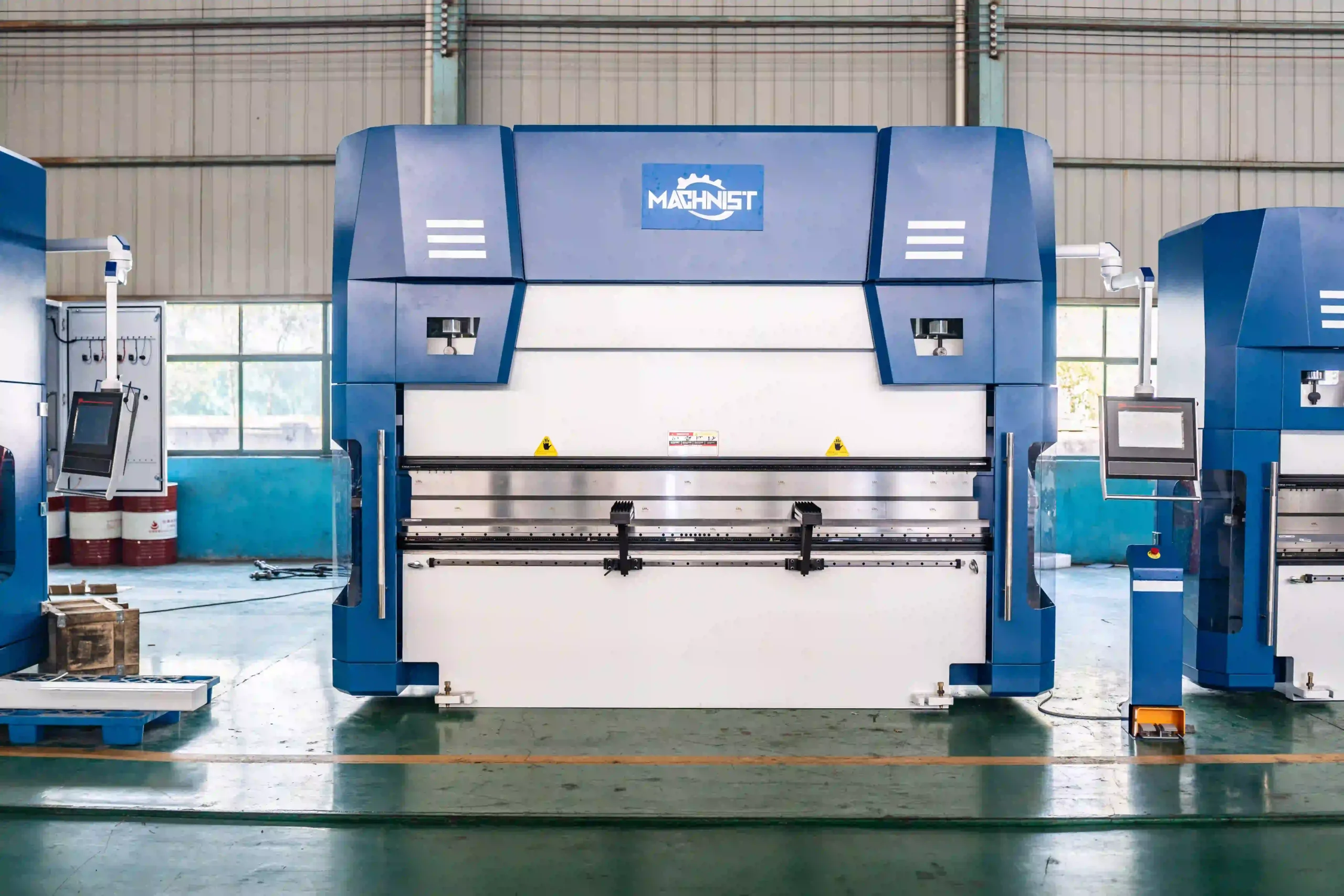
In the example above, the calculated requirement is approximately 165 metric tons. A 170T/3200 press brake is close to that value, but it leaves only a very small margin for material variation, thickness tolerance, tooling selection or future production changes.
170T / 3200
May be evaluated when 6 mm × 3,000 mm bending is occasional, material strength is confirmed and V48 standard air bending is acceptable.
200T / 3200
Provides a more reasonable operating margin when 6 mm × 3,000 mm bending is a regular production requirement.
Real production must account for:
- Actual tensile strength that may be higher than the assumed value.
- Variation in material batches and sheet thickness tolerance.
- Possible use of a smaller V opening to achieve a tighter radius.
- Future parts requiring thicker materials or special forming operations.
- Long-term reliability when the machine is used in regular batch production.
Professional recommendation: Machine selection should not be based on a press brake that can barely complete the maximum part. It should be based on stable and repeatable production under the customer’s real operating conditions.
Before Requesting a Quotation
What Should a Buyer Provide for Accurate Selection?
A complete recommendation can only be made when the machine supplier understands the real part requirement, not just a nominal sheet thickness.
More Than Machine Tonnage
Tooling and Load Capacity Must Also Be Verified
Even when the press brake has adequate rated tonnage, the selected upper tool, lower die, clamping system and working table must safely carry the load applied over the actual bending length.
This is particularly important when high force is concentrated on a short workpiece, when a small V opening is selected, or when special forming tools are used.
- Verify upper-tool and lower-die load ratings.
- Confirm clamping and crowning system capacity.
- Review concentrated and off-center bending loads.
- Confirm tooling before production of special formed parts.
Frequently Asked Questions
Press Brake Tonnage FAQs
Can tonnage be recommended from sheet thickness only?
No. Sheet thickness is only one input. Material strength, maximum actual bend length, V-die opening and forming method must also be confirmed.
Does a 3,200 mm press brake always require calculation at full 3,200 mm length?
No. Tonnage should be calculated using the maximum actual bending length required on the thickest workpiece. A shorter heavy part may require substantially less total force.
Does 6 mm mild steel over 3,000 mm always require a 200T machine?
For standard air bending with a V48 lower die and assumed 450 MPa tensile strength, the theoretical force is approximately 165 metric tons. A 170T model may be reviewed for occasional work, while a 200T machine is generally more practical for regular production.
Can a larger V opening reduce the required machine tonnage?
Yes, a larger V opening reduces bending force, but it also increases the natural inside radius and minimum flange length. The workpiece drawing must permit the larger die opening.
Can stainless steel be calculated in the same way as mild steel?
The same calculation logic applies, but the material factor must be adjusted according to actual tensile strength. Stainless steel and high-strength steel should not be calculated using a mild-steel assumption.
Can hemming or offset bending use the standard air-bending force result?
No. Hemming, offset bending, multi-bend tooling and special forming processes require separate evaluation based on the tooling and forming method.
Technical Reference Sources
The calculation principles and tooling considerations discussed in this article are based on publicly available technical resources from established press brake and tooling specialists.
Not Sure Which Press Brake Tonnage You Need?
Send us your material type, sheet thickness, maximum bend length and part drawings. The MACHNIST engineering team will calculate the required forming force and recommend a suitable CNC press brake, controller, backgauge and tooling configuration.